


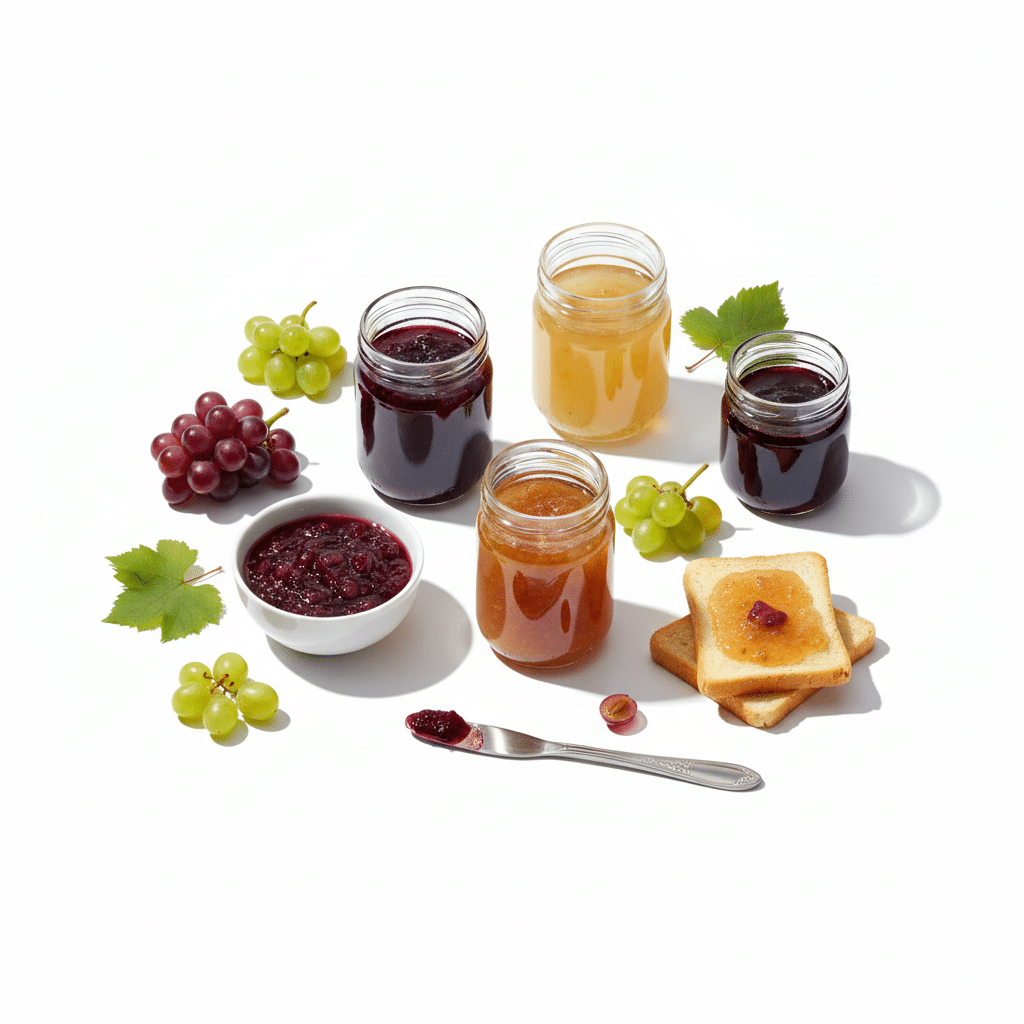
How to reformulate jams without added sugars using grape juice concentrate: preservation, natural color, antioxidants, and key points when choosing a supplier.
Jam remains a classic… but the consumer has changed. Today people look for a short label, recognizable ingredients and fewer refined sugars, without giving up texture, shine and flavor. In that balance, grape juice concentrate (and its rectified or high-color versions) is earning its place in premium formulations: it sweetens, helps preserve and provides natural color.
Jam is present at breakfast tables, in pastry making and across global gastronomy. But its formulation has evolved: today it is sweetened, enriched or improved with healthy natural ingredients, such as grape juice concentrate.
| Ingredient | Provides sweetness | Provides color | Typical use in premium jams |
| Sucrose | Yes (high) | No | Standard sweetness and structure, but with less “natural” storytelling. |
| Grape juice concentrate | Yes (natural) | Depends on the profile (white/red) | Sweetening + adding body and a fruity nuance. |
| Rectified grape juice concentrate 65º °Brix | Yes (natural, more neutral) | No (colorless) | Sweetness without affecting flavor or color. |
| High-color red concentrate | Yes (natural) | Yes (high, due to anthocyanins) | Natural color enhancement and visual differentiation |
History and evolution of jams
Before jars with “twist-off” lids existed, preserving fruit was pure ingenuity. In ancient Greece and Rome, fruits were already cooked with honey to extend their shelf life, and in the Middle East cane sugar eventually shaped the modern concept of jam. Over time came pectins, acidity control and industrial standardization… and now we are seeing another shift: reformulating to reduce added sugars and remove additives that consumers no longer want to see on the label.
A workshop curiosity: the “perfect” texture is not an accident. It depends on a delicate balance between soluble solids, pectin and pH. That is why any change in the sweetener forces you to think like a technologist, not just like a cook.
Ingredient innovation: natural alternatives to sugar

Reformulation often begins with an uncomfortable question: how do I reduce sucrose without the jam losing body or stability?
In the market we see three main approaches:
- Direct sugar reduction + adjustment of pectin and acidity.
- Use of intense sweeteners (with their challenges regarding aftertaste and labeling).
- “Sweet” ingredients of fruit origin: purées, concentrates and extracts that provide soluble solids and sensory profile.
This is where grapes have an advantage: they are naturally rich in sugars and phenolic compounds. And when properly processed, they can provide more than sweetness: they round out aromas, add shine and help build a story of origin (“only fruit”).
Why removing added sugars is becoming a trend
It is not just a trend. In Europe, nutritional claims such as “no added sugars” have specific conditions of use: no mono- or disaccharides may be added, nor other foods used for their sweetening properties, and if the food naturally contains sugars, this must be indicated.
This is also linked to the public health context: the WHO recommends reducing the intake of free sugars (ideally below 10% of daily energy and preferably below 5%).
For the end consumer, the result translates into three clear perceptions:
1) less cloying sweetness,
2) more “fruit flavor”,
3) more trust when the label does not look like a laboratory.

The functionality of grape juice concentrate in fruit preserves
When we talk about grape juice concentrate in jams, we are not just talking about sweetening. We are talking about preservation technology.
In a well-formulated concentrate, the high concentration of soluble solids (high °Brix) reduces water activity and therefore makes microbial growth more difficult. This allows manufacturers to work with cleaner recipes and, in many cases, reduce the need for preservatives.
In addition, the naturally occurring sugar profile in grapes (mainly glucose and fructose) provides sweetness with a different perception than sucrose. And if a more neutral “grape extract” is used, for example rectified grape juice concentrate, sweetness can be achieved without interfering with the flavor of the main fruit, which is very useful in strawberry, peach or apricot.
Natural color and antioxidants: the “grape effect” without chemicals
The anthocyanins in red grapes (especially in varieties with high coloring power, such as Garnacha Tintorera) allow attractive tones in jams without resorting to artificial colorants.
And there is another detail that is sometimes forgotten: beyond color, the phenolic fraction can provide functional value (antioxidants) and a more complete product story. In pastry and preserves, this argument works especially well when the manufacturer communicates origin, variety and traceability without promising miracles, simply explaining what is there.
Why is grape juice concentrate used in jams and jellies?
Jams, jellies and fruit spreads are semi-solid matrices designed to preserve fruit through a combination of sugars, pectins and controlled acidity. Beyond their sensory profile, consistency, sweetness and aromas, these foods are systems that maintain a balance between soluble solids and water activity. This balance determines both the texture of jams and their shelf life. Traditionally, sucrose has been the key element in this equilibrium. However, consumer expectations have evolved, and the market along with them: people demand cleaner labels, more natural ingredients and reduced refined sugars.
Therefore, reformulating jams without compromising functionality or food safety is essential. In response to this need, grape juice concentrate positions itself as both a technological and commercial solution. It has attracted the interest of the food and beverage industry from several perspectives: replacing part of the refined sugar, improving food preservation, enriching the product and reinforcing the narrative of naturalness and health.
Provides 100% natural sugars
Grape juice concentrate provides exclusively fructose and glucose, the natural sugars of grapes. Unlike cane sugar (sucrose), which is a disaccharide composed of two bonded molecules of glucose and fructose, in grape juice concentrate these sugars are already separated into monosaccharides, simple sugars that the body processes easily.
When making jams with grape juice concentrate, sweetness comes only from the sugars present in the grape juice itself, which makes it possible to reduce or completely eliminate refined sugar in the formulation. This allows products to be labeled as “no added sugars”. It is a formulation that is especially attractive to “clean label” consumers or to mothers looking for healthier fruit spreads for children.

Contributes to preservation
Grape juice concentrate is a highly viscous liquid with a dense consistency and high °Brix. This means it contains a high concentration of sugar (only fructose and glucose). There is also rectified grape juice concentrate, which is a dense and colorless mixture, 100% natural sugar, with an approximate concentration of 65 °Brix.
Fruit concentrates with high sugar concentrations (high °Brix) show excellent microbial stability compared with other juices, since water activity is lower, naturally inhibiting microbial growth. This reduces the need for preservatives and extends product shelf life while also providing natural sweetness to foods. For this reason, grape juice concentrate is traditionally used as a natural preservative in jams, jellies and fruit spreads.
Provides natural color
Grapes belong to the purple spectrum of foods. They contain anthocyanins, natural chemical compounds found in the grape skin that give them their characteristic color. These compounds are what give grape juice concentrate intense shades of red, purple or violet.
At JULIAN SOLER we offer different profiles of grape juice concentrate, including that of the Garnacha Tintorera variety, a unique grape with high coloring power that contains anthocyanins both in the skin and in its fleshy pulp, as well as distinctive aromatic notes. When high-color grape juice concentrate is incorporated into a jam or jelly, the visual appearance improves significantly, adding natural shades ranging from crimson to burgundy. In this way a deep and attractive color is achieved naturally. This avoids the addition of artificial colorants and aligns food products with the demand for clean labels.
Improves flavor: acts as a sweetener and flavoring agent
Grape juice concentrate, beyond its sweetening capacity, has a complex fruity flavor profile that enriches jam. Depending on the grape variety, climatic conditions, level of ripeness or harvest conditions, the grape juice concentrate can offer anything from sweet and smooth flavors to intense acidity or pronounced fruity notes, always the authentic taste of the grape. It also acts as a flavoring agent to add complexity or reinforce the original fruit character of the product, with deeper notes.
Main applications of grape solutions in jams and jellies
At JULIAN SOLER, our in-house R&D laboratory allows us to offer grape juice concentrate with customized characteristics, different quality grades, and to work together with our clients in the development of new products. We have the technical and technological capacity to provide special grades of grape juice concentrate with specifications tailored to the food and beverage industry, such as sulfite-free concentrates, organic options, sustainable solutions, Baby Food grade, low-color whites, high-color reds with antioxidant power, adjusted Brix levels, acidity and more.
In the field of jams and jellies, our grape juice concentrates have broad applications. For example:
- Organic jams with no added sugars, made with grape juice concentrate. For example:
- Strawberry jams with grape juice concentrate.
- Orange jams with pineapple and grape juice concentrate.
- Orange or peach jams sweetened with white grape juice concentrate instead of cane sugar.
- Fruit spreads, with grape juice concentrate to add natural color and flavor.
- Natural fruit compotes, to which organic grape juice concentrate is added. They have the same consistency and texture as conventional jams but contain fewer sugars. For example:
- Blueberry or strawberry compotes with grape juice concentrate, fruit pectin and lemon juice.
In “clean label” formulations
Grape juice concentrate is mainly used as a natural sweetener in formulations for jams, jellies, preserves, compotes and other spreads. As it is a 100% grape juice ingredient, it can be highlighted on the food label. This strategy captures the attention of consumers looking for more natural foods.
As a natural preservative
Grape juice concentrate improves food safety and shelf life. It is used in the formulation of jams, jellies, compotes, gelatin desserts and fruit spreads to increase product stability. Ideal for foods that will have a long shelf life in the pantry while avoiding the addition of chemicals and synthetic preservatives.
As a source of nutritional value
Grape juice concentrate is rich in vitamins (A, C, E, K…) and minerals (magnesium, calcium, potassium, iron…), which support key physiological processes in the body to maintain health. It also contains bioactive compounds such as resveratrol, an antioxidant with recognized activity that helps prevent cellular damage, has cardioprotective capacity, slows aging and helps prevent the appearance of cancer cells.
The remarkable content of nutrients and micronutrients in grape juice concentrate elevates the profile of jams and jellies, turning them into functional foods that provide health benefits. Grape juice concentrate can also be used to offer indulgence. Jams have traditionally been products high in sugar and carbohydrates. By adding grape juice concentrate, in addition to improving the nutritional profile, sugars are reduced and artificial flavorings or colorants are avoided. This allows manufacturers to position foods as healthier products, highlighting the beneficial effects of grape juice concentrate.
As a premium differentiation tool
Today’s consumer pays for experience, origin, authenticity, quality ingredients and exclusivity. Grape juice concentrate is an ingredient with a recognizable origin that brings jams and jellies more attractive flavors, textures, colors and aromas, an intense natural color and a complex aromatic profile… These qualities convey a perception of higher quality. When the sensory properties of jams are fully optimized, the nutritional profile is enhanced and only 100% natural ingredients with controlled traceability are used, it becomes possible to create a premium food product.
A study demonstrated the improvement of the sensory aspects of guava jam thanks to the addition of grape juice concentrate. In addition, the jam enriched with grape juice concentrate showed a phenolic content (antioxidants) more than double that of the standard formulation.

How to choose a grape ingredient supplier
When choosing a good partner for developing a “no added sugars” product line, these points can save you weeks of trial and error.
- Real traceability (vineyard >> plant >> batch).
- Year-round supply capacity (planning and stock).
- Available product profiles: low-color white, red, high-color, rectified, SO₂-free, organic, baby food. In short, conventional or special-quality products.
- Technical support: know-how with an R&D laboratory and support during reformulation.
- Certifications and food safety aligned with your target market.
JULIAN SOLER, grape juice concentrate delivered anywhere in the world
At JULIAN SOLER, grape juice concentrate begins in the vineyard, in Manchuela, a region of Castilla-La Mancha where grapes grow with a unique authenticity and with nutritional and sensory qualities that win over the most demanding markets. Our hybrid model, in which we process our own grapes and those of more than 300 local growers, allows us to control quality and traceability from origin to guarantee stable supply. This is what enables us to be your GLOBAL GRAPE SOLUTION SUPPLIER ALL YEAR ROUND.
We guarantee our clients stock 365 days a year. Every drop of grape juice concentrate is stored at controlled temperature thanks to advanced refrigeration and freezing chambers. In this way we supply concentrated red grape juice concentrate all year round. It is a unique process that allows us to deliver only high-quality grape juice concentrate.
Where do you need grape juice concentrate? We offer different shipping formats: bulk or packaged, in IBC containers, drums, flexitanks and other industrial formats. JULIAN SOLER grape juice concentrate reaches more than 60 countries. Request a sample.


 by
by